Monday, February 28, 2011

Empirical research in CSCW

First of all, apologizes for posting a bit late. I hope someone is still reading our blog, although the official blogging part of our course is over.

The topic of our last lecture was about groupware evaluation. Altough evaluation is critical for designers and practitioners, it also seems to play an important role in scientific research. In 2000, Pinelle and Gutwin [1] provided a review of evaluation methods used in papers from ACM CSCW conference proceedings 1990-1998. They selected all papers that introduced or evaluated a groupware system. They found that 17 of all 45 papers did not contain any formal evaluation. Further, 13 papers included controlled laboratory experiments and only 1 paper described a field experiment. The remaining papers relied on less rigorous field tests or explorative evaluations.

In 2007, Wainer and Barsottini [2] conducted a similar analysis of ACM CSCW papers published between 1998-2004. Unlike Pinelle and Gutwin, they also included papers with no groupware systems or evaluations. Two major differences between the results were discovered: significant increases of using field experiments and quantitative data. In general, experimental research with rigorous hypothesis testing seemed to be an increasing trend.

Personally I hope this trend keeps increasing in the future. In the end, scientific research is not about creating fancy systems and testing if they work. It's about creating knowledge, generalizable to a wide range of applications. As summarized by Wainer and Barsottini:
"Creativity, in natural sciences, comes in the proposal of new theories and hypothesis, and progress comes from systematically testing the theories and hypothesis with well planned, precise, and rigorous experiments."


[1] D. Pinelle and C. Gutwin. A Review of groupware evaluations. In Proceedings of WETICE2000,
pp. 86–91. IEEE Computer Society, 2000.

[2] J. Wainer, C. Barsottini. Empirical research in CSCW – a review of the ACM/CSCW conferences from 1998 to 2004. Journal of the Brazilian Computer Society 13 (2007) 27–36.

Sunday, February 27, 2011

Facebook & Privacy issues

In my last blog post I'll be pointing out an issue that's been bothering me as long as we've had the wonderful, joyous, utterly great Facebook available for use. It is how Facebook ignores and overlooks user privacy issues – and especially how it has the habit of not informing about changes, which are constantly made on different user profile settings, etc.

As I've understood, most of us (at least somehow IT and computer oriented users) are less or more aware of how Facebook is lacking visibility and just not telling, how it handles user privacy issues. Usually we users do not appreciate these things, and it's quite common that from time to time, there's some informative posts on status feed, when someone has found out some new privacy hole or unfair protocol, and users have to inform each other, how to change their settings in order to maintain control for example over it, what it's automatically told about you, for example when your name is simply googled by someone. So, people don't like these thing, but they are tolerated, for the sake of profits using Facebook on the other hand gives.

Below there's a link to a graph which illustrates, how privacy issues of Facebook have evolved over time. It certainly gave me thoughts, hopefully it will for someone else too...

http://mattmckeon.com/facebook-privacy/

PS. I tried to find some paper that would introduce a good guideline for privacy ethics on social online services and communities, but didn't find any (only marketing and consumer privacy papers were found). It would be interesting to read some paper related especially on social services...

Friday, February 25, 2011

Google Wave

I wan´t to talk about the Google Wave which was supposed to be the next generation of e-mailing. It combines e-mail, instant messages, wikis and social networking and was centered on online real-time collaboration.

The idea was to evolve the use of e-mail as to make it more conversational by showing all the messages as one conversation (the Wave). It includes IM:s so that users can have real-time conversations as in the IRC. Users can also edit messages and files as collaborative works and embed them in wikis, blogs and forums.

This next big thing was introduced by Google in 2010 but soon after the release it was handed over to Apache Software Foundation which continues to develop it as Wave in the box -server based product. The reason was that it was too confusing to use and people didn´t know how all things should work together. It was called "overhyped disappointment for the first generation of users" by the Linux Mag 2009.

I tried it when it was released to public in 2010, because the idea sounds pretty amazing. I didn´t need a lot of time to realize that although the idea is good, it isn´t easy to implement all those things together so easily.

But although the first release wasn´t what we all expected there is still hope in the WIAB project.

Thursday, February 24, 2011

Writeboard

Writeboard is a collaborative writing tool that is, like google docs, easy to use and efficient.

It lets users to write, review and edit any document, see several previous versions of the document and even work on the previous versions if the latest version is not what a user wanted to have. Hence it makes the comparison of different versions of a document alot easier.

A person can create his on writeboard, give it a password and then invite others to work together on any document. The person who is invited does not need to have a user account to get access to the writeboard but the link of the writeboard and the password to access it is sent which is enough to work on the writeboard.

Tuesday, February 22, 2011

About Separate Writers Strategy

It was noticed at the lecture that many use for example Word document in groupworks
document writing. In my case, many of the documents that are done in groupworks, are written so that the group decides what and who writes and then the actual writing is done individually in different places and time. In Posner's paper [1] this is called separate writers strategy. Here I'm going to discuss a little about the separate writers strategy in a situation where the document isn't handled in one place and time.

Good side in separate writers strategy in my opinon is, that everyone can write what is agreed when ever they wan't (of course keeping in mind the deadlines). That's also sometimes a bad side, since the written text is often depended on earlier text. Waiting for others might not be nice...

After everyone have written their part of the document, someone should review the text. It is sometimes hard to follow which text part should be where and it is someones duty to add all the text together and make everything sound fluent (different writing styles often occur..). This problem with lacking uniform style was noticed in Posner's study [1]. It is said in the paper that "Following the separate work there still remains the need to unite the resulting segments in order to create a uniform style.". That creates more work and who should do the uniting?

I think that the relationships between the writers has an influence in the writing style.  Posner's study also says that separate writing can be effective when writers understand one another. Posner's paper presents an example of a pair of researchers who had a long history of working together. They had all details clear when they started to write and they send the document back and forth and gave feedback to each other. I think that it shows how the document shaping can happen fluently when writers know each other and have a history together. Giving feedback might be easier.  I have also noticed that writing a document with people I have worked with earlier, is more fluent and maybe the sharing of work is more easier to decide.

Here are some of my thoughts, what are yours?

References:
[1] Ilona R. Posner and Ronald M. Baecker, How People Write Together. Proc. 25th HICSS Conference, 1992.

Sunday, February 20, 2011

Social Navigation: browsing like ants

We are influenced by others in everything we do. Our behavior in the Web is no exception. As noted by Dieberger et al. [1], however, most of the Web sites are not designed to support this kind of social behavior. They coined a term "social navigation" to describe navigation that is informed by the actions of others.

Dieberger et al. discuss that we often utilize social navigation in the physical world [1]. Similar behavior can also be observed in other species. In particular, ants use this kind of navigation pattern to find food around the nest, following pheromone trails left by other ants. The analogy is well described by van den Berg et al. [2]:
"The ability of ants to find efficient (i.e. short) routes between nests and food sources suggests an approach to cost-effective, flexible and implementable wayfinding support. Paths identified by ants are not pre-planned, but emerge, spontaneously, as a result of indirect communication between members of an ant colony - a form of indirect social navigation."
It seems reasonable that social navigation should be supported by design, as it simplifies our decision making. For example, it is easier to find interesting books in Amazon based on the recommendations.

However, I'm a bit concerned by this in some scenarios. Should we really design Web services that try to guide our decisions to match the decisions made by others? Taken to the extreme, are we becoming ants that just follow the footsteps of others? Making some decisions is difficult, and sometimes design should reflect that. So let's design for "individual navigation" that encourages users to think for themselves.


[1] A. Dieberger, P. Dourish, K. H\&\#246;\&\#246;k, P. Resnick, and A. Wexelblat. 2000. Social navigation: techniques for building more usable systems. Interactions 7, 6 (November 2000), 36-45. DOI=10.1145/352580.352587 http://doi.acm.org/10.1145/352580.352587

[2] Bert Van den Berg, Rene Van Es, Colin Tattersall, Jose Janssen, Jocelyn Manderveld, Francis Brouns, Hub Kurvers, and Rob Koper. 2005. Swarm-based Sequencing Recommendations in E-learning. In Proceedings of the 5th International Conference on Intelligent Systems Design and Applications (ISDA '05). IEEE Computer Society, Washington, DC, USA, 488-493. DOI=10.1109/ISDA.2005.88 http://dx.doi.org/10.1109/ISDA.2005.88

About activity theory and WoW

During this week I've been thinking about the activity theory introduced in the slides [1.] and also about computer games in which there's a strong social aspect present. Gaming has been discussed on other posts on this week as well. [2],[3]

As most of us probably know, today's most popular MMOPRG is World of Warcraft. WoW has 12 million subscribers [4]. The social aspects of the game play in mind, I've been wondering especially why Wow is so popular...

Maybe the most interesting thing is that it is the community of players themselves who create most of the content of the game. The story, the characters, the adventures, the fights. So it seems quite obvious that the key issue (at least one of them) in the gaming is it's social nature.

Citing what's been said about the activity theory on the slides: “Using activity theory as a framework suggests that program development must attend not only space, the external physical context, but also to the context the individual brings to the situation, the context of the tool/device, the information context, and finally the context created by the activity itself” [5]. It seems that the theory goes very well with WoW. Players are the contributors, the game is the tool, there are common rules, and so on. Finally the outcome of the process is the whole, social gaming experience.

[1] https://learning.uta.fi/mod/resource/view.php?id=203938
[2] http://mission-groupware.blogspot.com/2011/02/gratification-of-online-games.html
[3] http://awarecrew.blogspot.com/2011/02/addiction-to-unreal-world-online.html
[4] http://en.wikipedia.org/wiki/World_of_Warcraft
[5] https://learning.uta.fi/mod/resource/view.php?id=203938, slide 47.

Saturday, February 19, 2011

virtual identity

A virtual identity is a persona used to interact with others on the internet. Because it is not associated with the user's physical body, the persona is infinitely malleable. In the physical world, an individual's identity is determined by visual, aural and textual cues that are given to the community to establish reputation. The elements, such as who, what, where and when, of an individual's life that traditionally establish identity in the physical world can be fabricated in the virtual world.

Types:

Among the several types of virtual identities are email, Twitter and Facebook accounts, user logins with passwords and avatars in virtual worlds. A virtual identity can reveal an individual's real identity. In Usenet newsgroups, visitors solicit information via bulletin boards. The credibility of the advice giver is at stake. The cost of misinformation to the user seeking information can be steep, according to the Sociable Media Group at the MIT Media Lab. In these environments, self-appointed advisers often use their real names and professional titles. In contrast, people use fabricated virtual identities, such as avatars, to participate in virtual worlds and online role-playing games.

Friday, February 18, 2011

Our online roles.

Is our online identity so much different than our real-life identity?

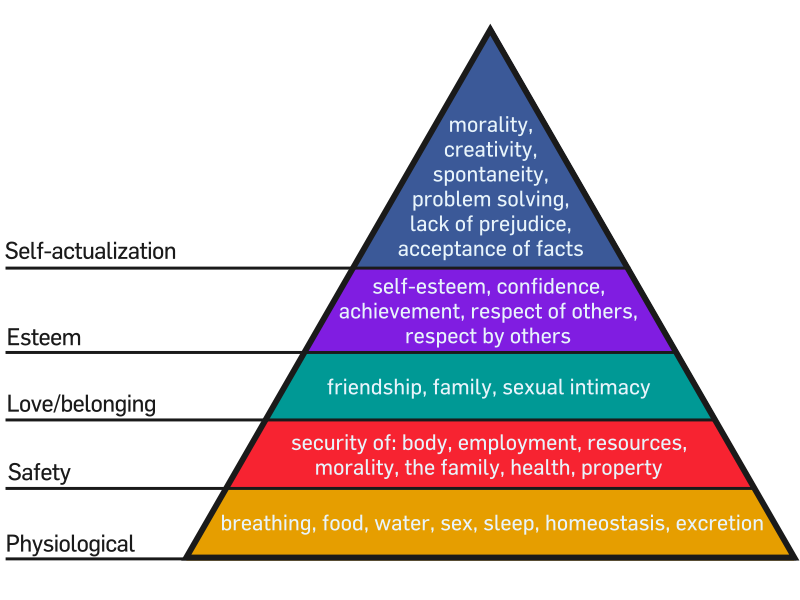
To find answer to this question, we should take a look at research done my Abraham Maslow in 1943 about hiearchy of needs [1].


Now compare those needs to this research done by Forrester research about user roles in social media [2]:


If you compare each of the steps of the ladder to each levels of the pyramid, you may notice that it goes suprisingly 1 on 1. This would mean that we act in online almost as we would act in normal life - our needs determine our actions.

What do you think? Are these two researches comparable?

I say yes

[1]http://en.wikipedia.org/wiki/Maslow%27s_hierarchy_of_needs
[2]http://forrester.typepad.com/groundswell/2007/04/forresters_new_.html

Thursday, February 17, 2011

Categorizing User Interests in Recommender Systems

Traditional recommender systems suffer from two problems.

1. The incomplete dataset results in poor recommendations.
2. Drifting preference where user preference change in time and the system does not provide the latest preferences as recommendations.

Different approaches have been used to overcome the problem of poor recommendations and drifting preferences. Saha, Majumder, Sanjog ray and Mahanti have proposed an algorithm to consider the Sparsity problem and preference shift and categorizes the user preferences in five categories.

1. Sporadic: Under this category comes the attributes that occur once in a while in the user's transactions.
2. New: These interests are new to the user but have been occuring more often in the user's recent transactions.
3. Regular: Once the user has subscribed to an attribute of interest considerable number of times, it is put in this category.
4. Old: The interests which are in the regualr category, fall in this category when they stop occuring in frequent successive transactions.
5. Past: An interest in the old category is shifted to Past when it does not occur any more and is then dropped from the preference's list.

I believe this algorithm is the most acceptable trying to solve these problems to the extent that the performane of recommneder systems can be improved incredibly.

Reference: http://iimcal.academia.edu/SouravSaha/Papers/262056/Categorizing_user_interests_in_Recommender_System

Tuesday, February 15, 2011

Opinions on few recommender systems

Like it is said in the lecture notes, interpretation of the rating scale can vary much. That's one reason why I like to see comments next to rating. I like to look for reviews and ratings for example about restaurants and certain products and I find it more informative to read what people actually think about the food or the item, than just to see a "4 star" rating.

I have used product suggestions in finding the items that I'm interested in. For example Amazon's book suggestions have helped me in finding good books and reviews made buying decision easier. It's nice to have some peer support in making decisions and finding the items in online shops too :).

I find implicit preferences one thing that encourage to navigate in a webpage. For example if we look at Youtube, we can see the most popular clips on the first page. This popularity is calculated from the times the clip has been viewed (at least I think so, correct me if I'm wrong). So yes, those clips on the first page can be the most viewed but are the the most popular..? In my opinion, no. Like it was mentioned in the lecture notes, watching a part of a video doesn't tell wether you like it or not.


References
Lecture notes: Recommender system slides
(Original slides by Juha Leino)

Sunday, February 13, 2011

About informal collaboration groupware

It was mentioned in the end of this week's lecture that maybe the future is in community-based groupware. It might surely be so, as it's what is happening in the society also on lager scale: people do their own thing (work or other) quite individually but are connected in the same time. And others can be informed what's been done almost instantly. So the focus is not on having people around some certain Electronic Meeting System focusing on the shared task, but rather doing the work independently but so that the groupware offers a way to communicate rapidly and without extra effort. “Groupware is organized around groups of people working independently, rather than shared applications, documents, or virtual places.” [1]

To me it makes a lot of sense, that people tend to get more done on their own. Typically a formal meeting includes lots of arrangements concerning the meeting, not the issue. An informal, different time groupware has less of these disadvantages and surely in some cases is more effective tool for group work.

1. Lecture slides (https://learning.uta.fi/mod/resource/view.php?id=202813)

Saturday, February 12, 2011

Software allows interactive tabletop displays on web

Researchers have developed a new type of software that enables people to use large visual displays and touch screens interactively over the Internet for business and homeland security applications.

These displays are like large iPhones, and because they are large they invite collaboration. So there is created a software framework that allows more than one display to connect and share the same space over the Internet. Users are able to pan and zoom using finger-touch commands.

Tabletop displays commercially available are the size of a coffee table. The researchers created a unit about twice that size - 58 inches by 37 inches - for laboratory studies.

Friday, February 11, 2011

Interactive Tabletops

About a three or four years ago I was participating in a technology demo workshop where they had this Microsoft Surface Interactive Multi-touch tabletop to show. They introduced us some photo viewing abilities, maps, games and all kind of effect demos it could pull off and boy was I impressed then [1]!


I´m somewhat of a fan of CSI (the original series),but I have always thought that they really exaggerate about their technology and computer software [2]. But as I watched the demo go on and played with the tabletop myself, I felt that those computers I work with really suck and how old-fashioned it is to use mouse and keyboard when you could do all these fancy things with just touch of a finger.


But the point of the workshop was not to show off with those fancy tech demos, but to really show us how easy it is to do group work on shared screen with that kind of system. We sat around the table, each seeing each other and we could do things simultaneously or take turns by rotating the view. I thought then that if working would be like this, it would feel like playing a party game all the time.

Here is alternative for student budjet [3]:


[1]http://www.youtube.com/watch?v=7WIkrQu0-v0

[2]http://www.youtube.com/watch?v=wX_i2vhnVKQ

[3]http://www.youtube.com/watch?v=pQpr3W-YmcQ&feature=player_embedded

Lessons from a Dozen Years of Group Support Systems Research

University of Arizona, after dozens of years of research on Group Support Systems (GMS), has listed a number of lessons they have learned from the past experiences working with induviduals as well as with groups supported by GSS.

They have found that although, individuals play an important role in solving some problems, there are situations however, which requires input and effort from groups of people, hence requiring collaboration and communication in a team. However, a team working using the GSS technology faces its own problems and so they have listed the lessons they have learned from the 9 key domains.
  1. GSS in organizations
  2. Cross-cultural and Mulicultural Issues
  3. Designing GSS software
  4. Collaborative writing
  5. Electronic polling
  6. GSS facilities & room design
  7. Leadership and facilitation
  8. GSS in the classroom
  9. Business process re-engineering
The lessons learned can help individuals and groups to foucs on the issues addressed and eliminate them with suitable and possible alternatives.

The paper can be found HERE for full list of lessons learned and benefit from them.

Wednesday, February 9, 2011

HP Halo Studio

Just a quick post about my personal experiences with a relatively high fidelity EMS: HP Halo Studio. Halo Studio is a dedicated meeting room where only one side of a table is reserved for co-located participants. The other side is covered by 3 large plasma displays showing remote participants. This allows a connection between 4 geographically separated Halo rooms.

From http://hphalo.org/
 Above the 3 remote participant displays, there is an additional display for sharing content. Sharing is supported from a laptop or physically through an overhead HD camera (e.g., sharing a paper document on the table).

One interesting aspect is that the system supports (to some extent) eye contact and spatial gesturing. This is achieved by a 3-axis controlled patent-pending camera system. Above all 3 remote participants displays, there is a video camera that can be rotated around 3 axis. I took a few photos from the "engine room" behind the displays:
 This seems to work surprisingly well. Overlapping talk and other turn taking problems still exist, but significanly less than in typical teleconference settings.

Tuesday, February 8, 2011

My experiences with one EMS

At work we sometimes use an electronic meeting system that consists of shared desktop and participant list. This system we use doesn't support voice or text chatting, so all the conversation has to happen with phone. It's only possible for one person or a meeting group to share their desktop at a time and changing the sharer is quite challenging. The participant list shows who are present and of course hearing them over phone helps too. All the participants can see the desktop sharers mouse pointer on the screen.

If I quickly think what I would change or add in this system, I would say that easier change of the shared desktop and conversation possibility (without extra phone). There isn't more support for awareness than the participant list, but that does't give any information about is anyone really listening or watching. But I wouldn't say that more awareness is needed in this case, since all the meetings are conserning work and everyone are (or at least should be) paying attention ;).

It would be nice to have meetings face to face when it involves explaining and brainstorming for example about pictures, but many times that's not possible because of long dinstances. When using these electronic meeting systems it is obvious that when they are designed well, it  helps to reduce work time and of course users are happy too.

Sunday, February 6, 2011

IRC vs. Facebook and MS Messenger – two against one?

Until recent years IRC was very popular and widely used. (Or at least more popular and more widely used that it is today.) Surely it is still used, but my experience is that its popularity is fading. In my social circles it is apparently so that Facebook has replaced IRC. The other reason seems to be that as “our generation” of IRC-users is getting older and for reasons like job and family has no time or interest to hang on IRC-channels, there are no newcomers any more. Generation Facebook probably feels that the text-based, non-graphical commucation medium is not appealing nor interesting. For same time messaging there's now Facebook chat, and for example widely popular MS Messenger.

As I listed the grounding constraints [1.] for them, I realized that they are quite similar, all the tree of them, IRC, Facebook chat and Messenger:

copresense: no
visibility: no
audibility: no
contemporality: no
simultaneity: sort of
sequentiality: yes
reviewability: yes
revisability: yes

IRC has advantages like logging and that you can have more than one person on the same conversation (with channels). I've understood that Messenger has the same feature (though I've never used it myself). But even if these three are quite similar with the ways of communicating, IRC is the one losing popularity. As I said, my guess is that it's because of text-based interface.

I think it's very unfortunate IRC isn't the way it used to be. It had a unique conversation culture and it was also a kind of “hobby” or “lifestyle”. People were there and talking even if they had nothing particular to inform or to ask. And on these occasion discussions developed spontaneously on various topics. In my opinion, both FB and Messenger are mostly media you use for some particular thing: to ask, to inform, to arrange something etc. Of course, in a conversation with just a one other person the discussion can be informal and the topics vary and change. But after you've shared your thoughts and feelings with your friend on that particular chatting session, and you've ended your discussion, does it have a habit to sparkle up again as you spontaneously start conversation for example about your favorite films or the daily news?

What I'm trying to say is, that when the members in the communication situation are both few and well-know to each other, the conversation tends to follow certain pattern(s). And perhaps you already know your friend's favorite movies so there's no need to talk about them. When the participants vary more, there's also possibility to have some new opinions on old topics and to start to discuss on something very different. In IRC there's quite low threshold to change topic or say something “out of ordinary”, and this sort of unexpectedness isn't typical when you discuss with a friend. On contrary, it's kind of rude if you just change a subject to something which has nothing to do with your previous topics!

Even with all these advantages I've listed, using IRC is less common than before. Personally I'd prefer interesting conversations over modern, attractive user interface, but obviously I'm in a minority (again...).

References:
1. Clark & Brennan (1991) Grounding in communication.
http://www-psych.stanford.edu/~herb/1990s/Clark.Brennan.91.pdf

Saturday, February 5, 2011

The Importance of Cell Phones In Our days

In our days, everybody has his own cell phone. There are a lot of kind of them. The most popular for today is smart phones. With them you can search on webpages, take video calls, send or get data files, listen music or watch some movies.

For young people is most important that cell phone has a lot of function. They usualy using it for sms or playing games. Cell phone for them is like communication tool with friends end parents.

There is another group of people witch using mobile phone for work. They really don't care about functions of sell phone. The most important things for them is reliability end the battery life of phone. Ussualy they have a realy big paymens for they calls.

End the last group of people is like people witch using phone to communicate with frends, relatives. For them is not very importat to have a cell phone end they don't care about funcionality of phone, they just use calls to communicate.
Text messaging is popularly utilized by many as the easiest way for them to express what they truly feel.
Cell phones have become a great tool for people to socialize and increase their networks easily.
Cell phones became a tool for people to share news and stay updated with the most important events.
Cell phones made relationships extra special as the most inspiring messages are disseminated through test messaging.

Cell phones have undoubtedly changed the usual pace of life that people used to lead. Be open for changes and enjoy the benefits that usually come with the innovations that happen because for sure the only thing that would linger in this world are those that created immense improvements on the lives of people.

Friday, February 4, 2011

IM, Email and Social Networks All-in one (Digsby)

Computers and internet have been part of our everyday life for a long time and many of us have been born in the middle of this interactive media. We seek information and we share it actively. We use social media services to tell people what is up with our lives and we seek information about others. Information is sought to help make decisions and status updates are done to tell others how you feel and where you are going. The amount of information that´s out there is overwhelming and yet we feel we must be aware of everything what´s going on out there. Why we do it? Because knowledge is power and wherever there is interaction and exchange there is quality of mind – collective intelligence [1].

Digsby (www.digsby.com) is a little piece of software that tries to provide help with this information overload. It is a multiprotocol IM client that combines AIM, MSN, Yahoo, ICQ, Google Talk and Jabber to one single buddy list. Not only does it handle all your IMs, it also handles your Email accounts (Hotmail, Gmail, Yahoo Mail, AOL/AIM Mail, IMAP, and POP account) and even your Social Networking messages from Facebook, Twitter, MySpace and LinkedIn accounts [2]. Sounds cool? It actually is!

I don´t remember how and when I came up with Digsby, but I must say all has been easy since. I´m using it to follow all my non-work related Emails, my MSN IM and my Facebook and LinkedIn profiles. Going those through all separately would take ages, but with Digsby it is as easy as it gets.

[1] David Skrbina, Participation, Organization, and Mind: Toward a Participatory Worldview, http://www.bath.ac.uk/carpp/publications/doc_theses_links/d_skrbina.html, 2008, 296[2] Digsby, http://www.digsby.com, 2011