virtual identity
A virtual identity is a persona used to interact with others on the internet. Because it is not associated with the user's physical body, the persona is infinitely malleable. In the physical world, an individual's identity is determined by visual, aural and textual cues that are given to the community to establish reputation. The elements, such as who, what, where and when, of an individual's life that traditionally establish identity in the physical world can be fabricated in the virtual world.
Saturday, February 19, 2011

Friday, February 18, 2011
Our online roles.
Is our online identity so much different than our real-life identity?
To find answer to this question, we should take a look at research done my Abraham Maslow in 1943 about hiearchy of needs [1].

Now compare those needs to this research done by Forrester research about user roles in social media [2]:

If you compare each of the steps of the ladder to each levels of the pyramid, you may notice that it goes suprisingly 1 on 1. This would mean that we act in online almost as we would act in normal life - our needs determine our actions.
What do you think? Are these two researches comparable?
I say yes
[1]http://en.wikipedia.org/wiki/Maslow%27s_hierarchy_of_needs
[2]http://forrester.typepad.com/groundswell/2007/04/forresters_new_.html
To find answer to this question, we should take a look at research done my Abraham Maslow in 1943 about hiearchy of needs [1].
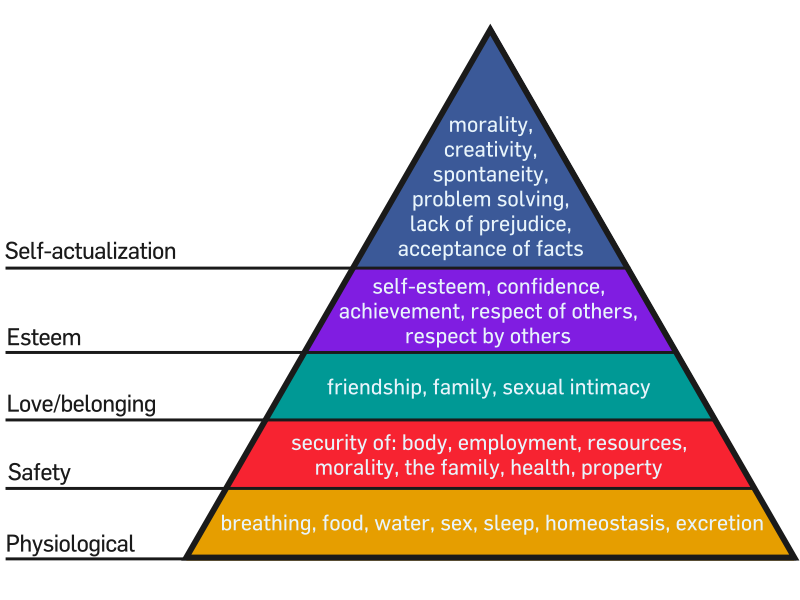
Now compare those needs to this research done by Forrester research about user roles in social media [2]:

If you compare each of the steps of the ladder to each levels of the pyramid, you may notice that it goes suprisingly 1 on 1. This would mean that we act in online almost as we would act in normal life - our needs determine our actions.
What do you think? Are these two researches comparable?
I say yes
[1]http://en.wikipedia.org/wiki/Maslow%27s_hierarchy_of_needs
[2]http://forrester.typepad.com/groundswell/2007/04/forresters_new_.html
Thursday, February 17, 2011
Categorizing User Interests in Recommender Systems
Traditional recommender systems suffer from two problems.
1. The incomplete dataset results in poor recommendations.
2. Drifting preference where user preference change in time and the system does not provide the latest preferences as recommendations.
Different approaches have been used to overcome the problem of poor recommendations and drifting preferences. Saha, Majumder, Sanjog ray and Mahanti have proposed an algorithm to consider the Sparsity problem and preference shift and categorizes the user preferences in five categories.
1. Sporadic: Under this category comes the attributes that occur once in a while in the user's transactions.
2. New: These interests are new to the user but have been occuring more often in the user's recent transactions.
3. Regular: Once the user has subscribed to an attribute of interest considerable number of times, it is put in this category.
4. Old: The interests which are in the regualr category, fall in this category when they stop occuring in frequent successive transactions.
5. Past: An interest in the old category is shifted to Past when it does not occur any more and is then dropped from the preference's list.
I believe this algorithm is the most acceptable trying to solve these problems to the extent that the performane of recommneder systems can be improved incredibly.
Reference: http://iimcal.academia.edu/SouravSaha/Papers/262056/Categorizing_user_interests_in_Recommender_System
Tuesday, February 15, 2011
Opinions on few recommender systems
Like it is said in the lecture notes, interpretation of the rating scale can vary much. That's one reason why I like to see comments next to rating. I like to look for reviews and ratings for example about restaurants and certain products and I find it more informative to read what people actually think about the food or the item, than just to see a "4 star" rating.
I have used product suggestions in finding the items that I'm interested in. For example Amazon's book suggestions have helped me in finding good books and reviews made buying decision easier. It's nice to have some peer support in making decisions and finding the items in online shops too :).
I find implicit preferences one thing that encourage to navigate in a webpage. For example if we look at Youtube, we can see the most popular clips on the first page. This popularity is calculated from the times the clip has been viewed (at least I think so, correct me if I'm wrong). So yes, those clips on the first page can be the most viewed but are the the most popular..? In my opinion, no. Like it was mentioned in the lecture notes, watching a part of a video doesn't tell wether you like it or not.
References
Lecture notes: Recommender system slides
(Original slides by Juha Leino)
Sunday, February 13, 2011
About informal collaboration groupware
It was mentioned in the end of this week's lecture that maybe the future is in community-based groupware. It might surely be so, as it's what is happening in the society also on lager scale: people do their own thing (work or other) quite individually but are connected in the same time. And others can be informed what's been done almost instantly. So the focus is not on having people around some certain Electronic Meeting System focusing on the shared task, but rather doing the work independently but so that the groupware offers a way to communicate rapidly and without extra effort. “Groupware is organized around groups of people working independently, rather than shared applications, documents, or virtual places.” [1]
To me it makes a lot of sense, that people tend to get more done on their own. Typically a formal meeting includes lots of arrangements concerning the meeting, not the issue. An informal, different time groupware has less of these disadvantages and surely in some cases is more effective tool for group work.
1. Lecture slides (https://learning.uta.fi/mod/resource/view.php?id=202813)
Saturday, February 12, 2011
Researchers have developed a new type of software that enables people to use large visual displays and touch screens interactively over the Internet for business and homeland security applications.
These displays are like large iPhones, and because they are large they invite collaboration. So there is created a software framework that allows more than one display to connect and share the same space over the Internet. Users are able to pan and zoom using finger-touch commands.
Tabletop displays commercially available are the size of a coffee table. The researchers created a unit about twice that size - 58 inches by 37 inches - for laboratory studies.
Friday, February 11, 2011
Interactive Tabletops
About a three or four years ago I was participating in a technology demo workshop where they had this Microsoft Surface Interactive Multi-touch tabletop to show. They introduced us some photo viewing abilities, maps, games and all kind of effect demos it could pull off and boy was I impressed then [1]!
I´m somewhat of a fan of CSI (the original series),but I have always thought that they really exaggerate about their technology and computer software [2]. But as I watched the demo go on and played with the tabletop myself, I felt that those computers I work with really suck and how old-fashioned it is to use mouse and keyboard when you could do all these fancy things with just touch of a finger.
But the point of the workshop was not to show off with those fancy tech demos, but to really show us how easy it is to do group work on shared screen with that kind of system. We sat around the table, each seeing each other and we could do things simultaneously or take turns by rotating the view. I thought then that if working would be like this, it would feel like playing a party game all the time.
Here is alternative for student budjet [3]:
[1]http://www.youtube.com/watch?v=7WIkrQu0-v0
[2]http://www.youtube.com/watch?v=wX_i2vhnVKQ
[3]http://www.youtube.com/watch?v=pQpr3W-YmcQ&feature=player_embedded
Subscribe to:
Posts (Atom)